Early Orthodontics • Age 7+

Phase I & Early Orthodontic Treatment

Anaheim Hills • Yorba Linda • Placentia • Orange

Guiding Growth at the Right Time

Early orthodontic treatment can help create space for growing teeth, improve developing bites, and guide jaw growth when treatment is appropriate.

Personally evaluated by Dr. Pejman Nasibi. Many children simply need monitoring — not treatment.

Growth Guidance Expansion Underbite Treatment Space Management
★★★★★ Trusted by Orange County Families
Dr. Pejman Nasibi with a happy family at My Orange County Orthodontist in Anaheim Hills
Personalized Early Orthodontics Anaheim Hills, California

Real Patients • Real Smiles • Anaheim Hills

Trusted By Anaheim Hills Families

Orthodontist with kids in Anaheim Hills
Trusted by Anaheim Hills families
Phase one orthodontic treatment in Anaheim Hills
Gentle care kids feel comfortable with
Happy family at orthodontist office
Families trust us with their smiles
Orthodontic consultation with Dr Nasibi
One-on-one care with Dr. Nasibi
Trusted by Anaheim Hills families
Gentle care kids feel comfortable with
Orthodontic care for the whole family
Families trust us with their smiles

Early Orthodontic Treatment in Anaheim Hills

Matilda’s Smile Transformation
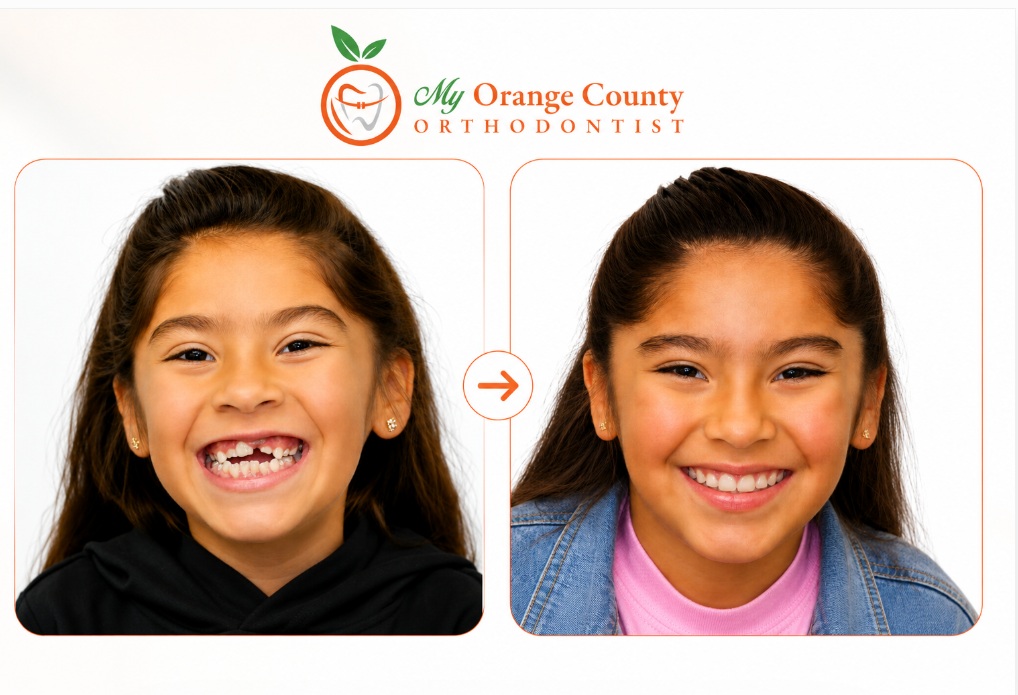
Before and after phase I orthodontic treatment for tongue thrust open bite and crossbite at My Orange County Orthodontist

At My Orange County Orthodontist, Matilda came to us with a developing tongue thrust habit, open bite, and crossbite — conditions that can affect facial development, speech, chewing function, and long-term bite stability.

Through carefully planned Phase I orthodontic treatment, we helped guide her jaw development, improve her bite relationship, and create proper space for healthy permanent teeth eruption. More importantly, we helped restore the confidence that every child deserves when smiling.

Phase I orthodontic treatment usually takes place between ages 7 and 10. The goal is to guide jaw growth, create space for permanent teeth, and correct developing bite problems before they become more severe. Treatment during this phase may include specialized orthodontic appliances designed to improve jaw alignment and dental development.

The American Association of Orthodontists recommends children receive their first orthodontic evaluation around age 7. At this stage, children have a mix of baby teeth and permanent teeth, allowing orthodontists to identify growth and bite problems early.

Early evaluation does not always mean early treatment is needed. In many cases, children simply need growth monitoring until the ideal time. Our philosophy is simple: honest recommendations and treatment only when it truly benefits your child.

Schedule Free Orthodontic Consultation
Phase I early orthodontic treatment before and after smile transformation at My Orange County Orthodontist

Orthodontic Appliances for Growing Children

Guiding Growth Early Creates Better Long-Term Results

Orthodontic appliance therapy is often used during early orthodontic treatment to guide jaw growth, create space for developing teeth, and correct bite problems before they become more severe.

Appliances such as Rapid Palatal Expanders (RPE), biteplates, lingual holding arches, facemasks, and tongue-thrust appliances help improve jaw development and prepare the teeth for future orthodontic treatment. These appliances allow orthodontists to correct problems early while a child’s jaw is still growing.

Correcting Overbites During Growth

Growth Modification for Developing Overbites

Some children develop a significant overbite because the lower jaw develops behind the upper jaw. When diagnosed early, growth modification appliances can help guide jaw development and improve facial balance while a child is still growing.

One of the most effective appliances for correcting a Class II bite and excessive overjet is the Herbst Appliance .

The Herbst appliance works 24 hours a day to encourage forward growth of the lower jaw and can significantly improve bite relationships in growing children.

Learn more about our Herbst Appliance treatment in Anaheim Hills and how it may help children with overbites, protruding front teeth, and developing jaw discrepancies.

Tongue Thrust & Habit Correction

Healthy Tongue Posture Shapes Healthy Growth

Phase I orthodontic treatment focuses on guiding jaw growth and correcting habits that can affect healthy dental development in children.

Early treatment, typically between ages 6 to 10, can address issues such as crowding, crossbites, open bites, and inadequate space for permanent teeth to erupt properly.

Some bite problems are related to tongue posture and swallowing patterns. A tongue thrust occurs when the tongue pushes against the teeth or rests too low in the mouth, often leading to open bites, flared front teeth, and orthodontic relapse later in life.

At My Orange County Orthodontist, our orthodontic team helps children improve tongue posture, eliminate harmful oral habits, and guide healthy jaw development for more stable, long-term orthodontic results.

Early Underbite Treatment

Correcting an Underbite While Your Child Is Growing

A developing underbite, or Class III bite, occurs when the lower teeth sit in front of the upper teeth. In some children, early orthodontic treatment can help improve the relationship between the upper and lower jaws while growth is still occurring.

Depending on your child’s needs, treatment may include expansion, facemask therapy, braces, or other orthodontic appliances. The goal is to improve the developing bite and create a healthier foundation for continued growth.

Learn More About Underbite & Class III Treatment for Children
Child with underbite and crossbite before early orthodontic treatment at My Orange County Orthodontist in Anaheim Hills

Before treatment: developing underbite and crossbite.

See the Transformation

Early Class III Treatment

Watch how early orthodontic treatment helped improve this young patient’s developing underbite and bite relationship.

Treatment Result

Before & After Early Treatment

Before and after Class III underbite early orthodontic treatment at My Orange County Orthodontist in Anaheim Hills

Before and after early orthodontic treatment. Individual treatment needs and results vary.

Early Orthodontic Evaluation

Does Your Child Have an Underbite?

If your child’s lower teeth sit in front of the upper teeth, an early orthodontic evaluation can help determine whether treatment is needed now or whether growth should simply be monitored.

Schedule an Evaluation

Signs Your Child May Need
Early Orthodontic Treatment

Crowded or Overlapping Teeth
Early or Late Loss of Baby Teeth
Difficulty Biting or Chewing
Mouth Breathing
Thumb Sucking After Age 5
Crossbite or Underbite
Protruding Front Teeth

Early Orthodontic Treatment for Families in Anaheim Hills

If you are searching for an experienced orthodontist in Anaheim Hills, Dr. Nasibi provides personalized orthodontic care for children, teens, and adults. Our orthodontic office proudly provides early orthodontic treatment for children in Anaheim Hills and surrounding communities including Yorba Linda, Orange, Placentia, and Villa Park.

Early evaluation allows us to monitor dental development, identify bite problems early, guide jaw growth properly, and determine the best time to begin treatment.

Early Orthodontic Treatment

Why Does Your Child Need an Orthodontic Check-Up Around Age 7?

Your child's teeth may look perfectly fine from the outside while important changes are happening underneath. Permanent teeth are developing, baby teeth are being lost, molars are moving and the jaws are continuing to grow.

An early orthodontic evaluation can help us identify problems at the right time, sometimes before they become much more difficult to correct.

🦷
Preserve Space Losing a baby tooth too early can sometimes allow permanent teeth to drift into space needed by developing teeth.
🌱
Use Growth Wisely Certain bite and jaw problems may be easier to address while your child is still actively growing.
👀
Find Hidden & Impacted Teeth Permanent teeth can sometimes become blocked or impacted beneath the gums. An early orthodontic evaluation can help identify abnormal eruption before the problem becomes more difficult to treat.
See Early Treatment in Action

Anterior Crossbite Correction

This young patient had a developing anterior crossbite, where the upper front teeth were positioned behind the lower front teeth. Early orthodontic treatment with anterior bite buildups and facemask therapy helped guide the bite into a healthier position during growth.

Early treatment can sometimes make developing bite problems easier to manage while a child is still growing.

Real Patient • Impacted Tooth

What Happens When a Permanent Tooth Gets Stuck?

Sometimes a permanent tooth is developing underneath the gums but cannot erupt into the mouth normally. This is called an impacted tooth. The problem may not always be obvious just by looking at your child's smile.

In this patient, X-rays helped us locate the impacted tooth and determine its position. After the tooth was carefully exposed, an orthodontic attachment was placed so we could gradually guide the tooth into its proper position.

An impacted tooth can be completely hidden beneath the gums. Early orthodontic evaluation and X-rays can help identify eruption problems before they become more difficult to manage.

Early evaluation doesn't mean early braces. Sometimes the best treatment is simply knowing what to watch and choosing the right time to act.

Why Age 7 Matters
The Most Important Question

Treat Now—or Wait?

Seeing an orthodontist at age 7 does not mean starting treatment at age 7. The purpose of an early orthodontic evaluation is to identify problems that may benefit from treatment while your child is growing—and just as importantly, to recognize when it is better to wait.

When Early Treatment May Help

Some problems are better evaluated early.

Phase I treatment may be considered when timing could make a meaningful difference in how the teeth, bite, or jaws develop.

Crossbite

Certain crossbites may affect how the upper and lower teeth come together and may benefit from correction while a child is still growing.

Developing Underbite

Some developing Class III or underbite relationships deserve early evaluation because growth can influence treatment options.

Eruption or Space Problems

Significant crowding, abnormal eruption, or permanent teeth that are not developing or erupting as expected may require closer evaluation or early intervention.

Jaw Growth or Bite Problems

Certain jaw relationships, significant protrusion, or developing bite problems may benefit from treatment or monitoring during growth.

Habits Affecting the Bite

Persistent thumb or finger habits, tongue-related habits, or other functional patterns may contribute to changes in the bite and should be evaluated individually.

When Waiting May Be Better

Sometimes the best treatment is no treatment yet.

Many children do not need Phase I orthodontics. When there is no meaningful advantage to treating early, monitoring growth and eruption may be the more appropriate approach.

Normal Dental Development

If permanent teeth are erupting appropriately and there is no significant developing bite problem, observation may be all that is needed.

Mild Crowding

Crowding alone does not automatically mean a young child needs treatment. In some cases, it is appropriate to monitor the developing permanent teeth before making a treatment decision.

No Clear Benefit to Starting Early

If beginning treatment now is unlikely to improve the eventual outcome or meaningfully change future treatment, waiting may avoid unnecessary time in orthodontic appliances.

Better Timing Later

Some orthodontic problems can be treated more efficiently after additional permanent teeth erupt or when a child reaches a more appropriate stage of growth.

Growth Can Be Monitored

Periodic orthodontic evaluations allow us to follow jaw growth and tooth eruption and recommend treatment if and when the timing becomes appropriate.

The goal isn't to start treatment early.
It's to start treatment at the right time.

At My Orange County Orthodontist in Anaheim Hills, Dr. Pejman Nasibi evaluates your child's teeth, bite, eruption, and growth before recommending treatment. If your child doesn't need treatment yet, we'll tell you.

Dr. Pejman Nasibi with a Phase I orthodontic patient at My Orange County Orthodontist in Anaheim Hills
Dr. Pejman Nasibi with one of our early orthodontic patients
Early Orthodontic Evaluation • Anaheim Hills

Does Your Child Need Treatment Now, or Is It Better to Wait?

That's exactly what an early orthodontic evaluation is designed to determine.

Dr. Pejman Nasibi will evaluate your child's teeth, bite, eruption, available space, and jaw development and explain whether early treatment may be beneficial or simply monitoring growth is the better approach.

No pressure to start treatment. If your child doesn't need orthodontic treatment yet, we'll tell you.
Questions Parents Ask

Early Orthodontic Treatment FAQs

Parents often wonder whether their child really needs orthodontic treatment at a young age—or whether it is better to wait. Here are answers to common questions about Phase I orthodontic treatment from Dr. Pejman Nasibi at My Orange County Orthodontist in Anaheim Hills.

What is Phase I orthodontic treatment?

Phase I orthodontic treatment, also called early or interceptive orthodontic treatment, is treatment performed while a child still has a combination of baby teeth and permanent teeth.

The goal is not simply to straighten teeth early. Phase I may be recommended when an orthodontic problem could benefit from treatment while the jaws are growing or while permanent teeth are still developing and erupting.

At what age should my child first see an orthodontist?

The American Association of Orthodontists recommends that children have their first orthodontic evaluation no later than age 7.

An evaluation at age 7 does not mean your child needs braces or an expander. It allows an orthodontist to evaluate how the permanent teeth are erupting, how the upper and lower jaws relate to each other, and whether a developing problem should be treated or simply monitored.

Does every 7-year-old need Phase I orthodontic treatment?

No. Many children who are evaluated around age 7 do not need orthodontic treatment at that time.

If the teeth and jaws are developing appropriately, Dr. Nasibi may recommend monitoring your child's growth and eruption rather than beginning treatment. Early treatment is considered when there is a specific problem that may benefit from intervention while the child is still growing.

How do I know if my child may need early orthodontic treatment?

Some problems that may deserve an early orthodontic evaluation include a crossbite, underbite, significant protrusion, severe crowding, difficulty with permanent teeth erupting, early or late loss of baby teeth, jaw growth differences, or oral habits that are affecting the bite.

Seeing one of these signs does not automatically mean treatment is necessary. An orthodontic examination helps determine whether treatment now or observation is the better approach.

Does my child need a palatal expander?

Not every child needs an expander. A palatal expander may be recommended when the upper jaw is too narrow, when certain crossbites are present, or when creating additional space may be beneficial for developing permanent teeth.

Whether expansion is appropriate depends on your child's individual jaw relationships, dental development, age, and orthodontic diagnosis.

Can Phase I treatment help an underbite or crossbite?

In selected children, early orthodontic treatment can help correct certain crossbites and developing underbites while the jaws are still growing.

Treatment depends on the cause of the bite problem. Options may include expansion, orthodontic appliances, braces, or growth-modification approaches. Some skeletal problems may continue to require monitoring or additional treatment as growth continues.

Can early orthodontic treatment prevent tooth extractions later?

Sometimes early treatment can improve space or guide dental development, but Phase I treatment cannot guarantee that future extractions will be avoided.

The need for extractions depends on factors such as jaw size, tooth size, crowding, facial growth, bite relationships, and how the permanent teeth develop. The goal of early treatment is to address the problem at the most appropriate time—not simply to avoid extractions.

Will my child still need braces after Phase I treatment?

Some children who complete Phase I treatment later benefit from a second phase of orthodontic treatment after more or all of the permanent teeth have erupted. Other children may require limited additional treatment or observation only.

Because every child's growth and tooth eruption are different, the need for future treatment cannot always be determined with certainty at the beginning of Phase I.

How long does Phase I orthodontic treatment take?

The length of Phase I treatment depends on the specific problem being treated and the appliance or orthodontic mechanics needed. Many early treatment plans are designed to accomplish a focused objective rather than completely straighten every permanent tooth.

After evaluating your child, Dr. Nasibi can explain the treatment goal and provide a more individualized estimate of how long treatment is expected to take.

Where can I get an early orthodontic evaluation in Anaheim Hills?

Dr. Pejman Nasibi provides early orthodontic evaluations at My Orange County Orthodontist in Anaheim Hills, California.

During your child's evaluation, we look at dental development, tooth eruption, available space, the bite, and jaw relationships. If treatment is not needed yet, monitoring growth and waiting may be the recommended plan.

An early orthodontic evaluation does not mean early treatment. Our goal is to identify the right treatment—at the right time—and to recommend observation when treatment can safely wait.